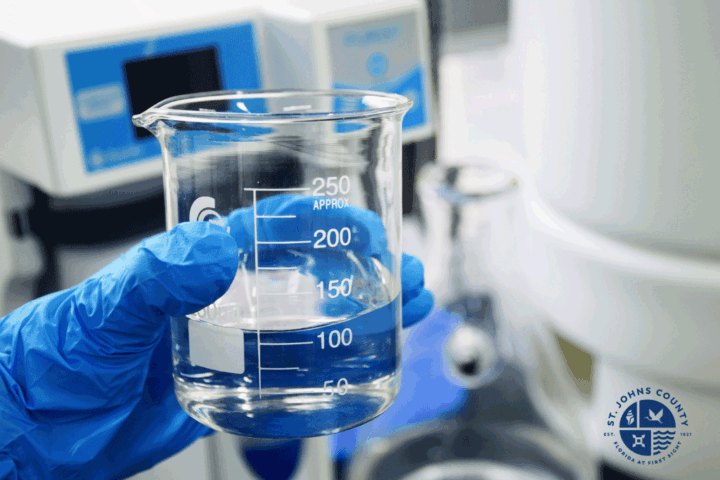
St. Johns County's utility lab runs roughly 25,000 water and wastewater tests every year to make sure what flows from the Floridan Aquifer to local taps meets state and federal standards.
The St. Johns County Utilities Department (SJCUD) highlighted that testing volume in a Wednesday, Aug. 26, announcement marking National Water Quality Month. The department draws its entire supply from the Floridan Aquifer, which it says serves about 90 percent of Florida's population.
"Providing safe, reliable drinking water is at the heart of our mission," said Neal Shinkre, the county's utility director. "Our team works every day to monitor water quality and maintain the systems our customers depend on …"
The testing matters more than usual right now. A Phase III Extreme Water Shortage Order from the St. Johns River Water Management District has applied to every address in St. Johns County since May 11. As of late July, the county was approximately 8.3 inches below its 12-month average rainfall, according to county records. The order was still in effect as of Aug. 13.
In March, when the district declared a Phase II shortage, Shinkre said that "small actions like adjusting irrigation schedules, checking irrigation systems for leaks, and watering only when necessary can make a meaningful difference during dry periods."
How residents can help
SJCUD outlined several steps residents can take to protect the water supply:
- Never flush medications. Do not pour unused drugs down a toilet or drain. The Drug Enforcement Administration (DEA) maintains a search tool to find authorized disposal sites.
- Drop off hazardous waste. Motor oil, gasoline, pool chemicals, pesticides and batteries can go to the Tillman Ridge Transfer Station at 3005 Allen Nease Rd. in Elkton or the Stratton Road Transfer Station at 250 North Stratton Rd. in St. Augustine. Both are open Monday through Friday, 7 a.m. to 6 p.m., and Saturday, 7 a.m. to 1 p.m.
- Follow fertilizer labels. Overapplication can push excess nutrients into groundwater and local creeks.
- Keep pollutants out of storm drains. Runoff from streets, yards and driveways flows into ponds and creeks.
- Fix leaks and maintain irrigation systems. Efficient water use helps protect the aquifer's long-term sustainability.
SJCUD publishes annual Water Quality Reports each July. Residents can view the latest results at sjcfl.us/water-quality-reports.
Residents with questions can reach the utilities department at (904) 209-2700.